Lud Schroedl · 16 August 2026
Admiration is not a valuation method
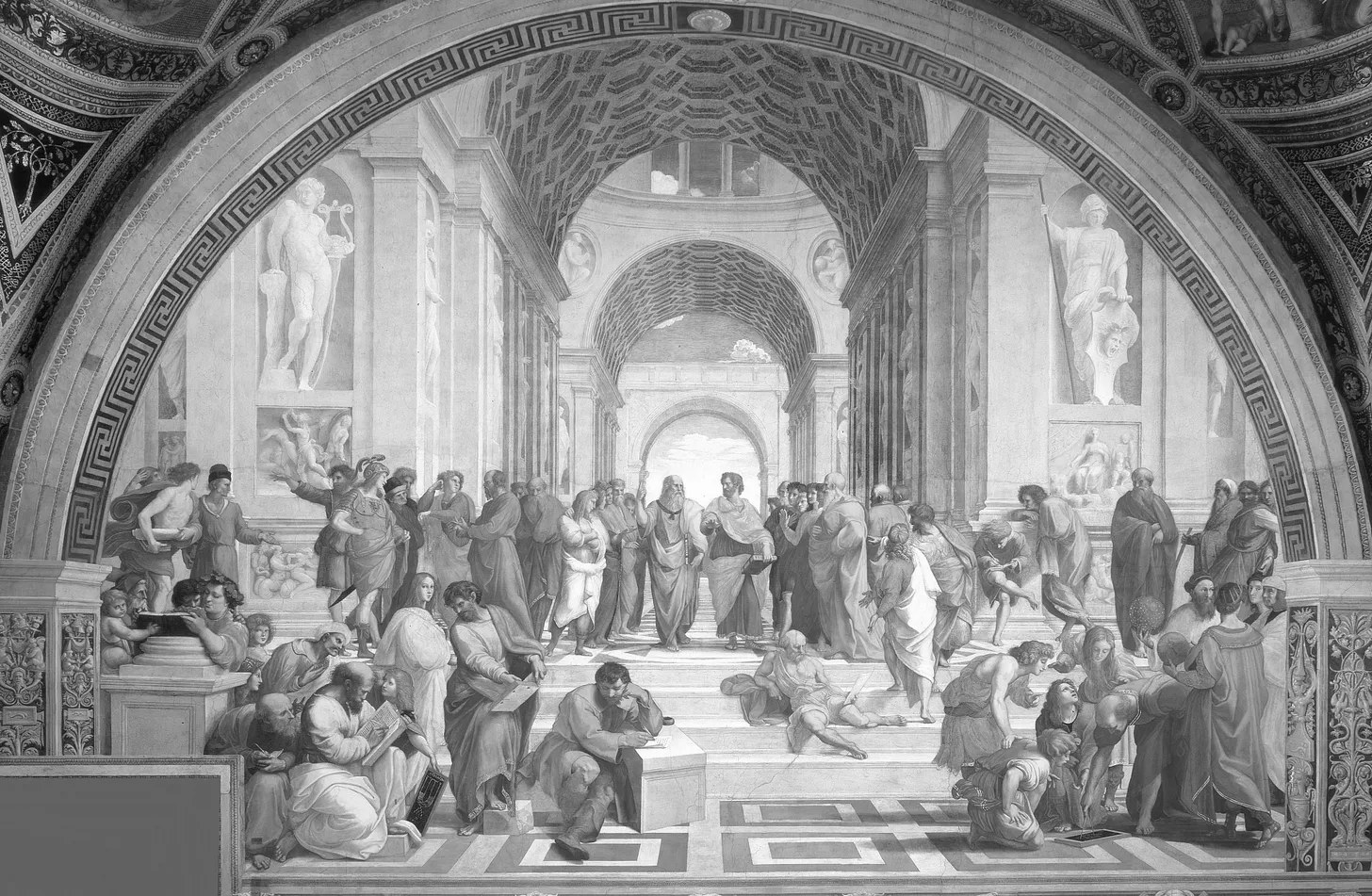
Dominance is taken. It runs on fear, and what it produces in everyone below is avoidance. Prestige on the other hand is given. It runs on admiration, and what it produces is approach. To understand dominance you watch the dominant, but to understand prestige you have to stop looking at the prestigious person entirely and look at the admirer, because prestige with nobody admiring is nothing, while admiration makes perfect sense on its own.
Which turns the whole thing into one question. What does the admirer get?
Amotz Zahavi's answer came out of decades watching a small desert bird called the Arabian babbler. Babblers compete to stand guard duty. They compete to feed each other, and to take the exposed end of the branch at night, where the predators come. The alpha will physically shove the beta off the lookout perch in order to take the risk himself. The beta will refuse food from the alpha while hungry. None of this is generosity. It is bidding. The bird that has done the most for the group is the bird the group can least afford to lose, and it gets paid in mating opportunities and in fights that nobody starts. Steven Pinker puts the system into one clause: prestige is public knowledge that you hold assets that would let you help others if you chose to.
So admiration is a teaming instinct. It attaches you to people who would be good to have on your side. It is old, it is mostly automatic, and it works well.
What it is not is a pricing instinct.
A company carries prestige the same way a person does. Its standing is the sum of other people's willingness to defer to it, which makes it a poll. A poll tells me what other allocators currently believe. That is information about the price and about the people setting it. It is not information about the business.
So every bid on an admired asset has two prices inside it. One is for the cash the thing will produce. The other is for being known to own it. Only the first pays a return. The second gets consumed the moment the wire goes out, exactly like any other consumption purchase, and it almost always gets booked as an investment.
There is one measurement I know of. Anginer and Statman took Fortune's annual survey of the most admired companies in America and ran it: between April 1983 and December 2007 the admired names returned less on average than the spurned ones. One study, one survey, one market, and admiration correlates with growth characteristics, so it does not cleanly separate a status premium from the value effect. I hold it as evidence, not as proof.
The mechanism underneath the second price is mimetic desire. Girard's claim is that we do not want things directly, we want them through models. The closer the model sits to you, the hotter the rivalry gets. A model far away is admired. A model in the next seat is a rival.
Zahavi found the same shape in birds without needing the vocabulary. Babblers compete hardest with the rank immediately next to their own. The alpha fights the beta over guard duty and barely registers the gamma.
The practical version of this is uncomfortable. My temptation set is not the opportunity set, it is my peer set. I am not going to be pulled toward what Berkshire owns. I am going to be pulled toward what the person one seat over closed last quarter, in his sector, at his multiple. Kierkegaard named the hinge long before anybody was measuring it: admiration is happy self-surrender, envy is unhappy self-assertion. When I cannot surrender to an adjacent peer's returns, I assert. Here, asserting means bidding. And from the inside, at the moment of the bid, envy is indistinguishable from conviction.
So the lever is not willpower. It is what I let myself look at. Whatever I watch daily sets what I will eventually pay.
Two things have made this heavier than it used to be, and they push in opposite directions.
Observing what other people own used to cost something. Internal mediation was bounded by geography, and your models were whoever you could physically see. Now ownership is published: portfolio pages, announced rounds, disclosed positions, deal lists circulated by the people who want you in the next one. Everybody is adjacent. Holding cash flows constant, that should mean expected return falls as ownership becomes more observable. I cannot separate that from the size and illiquidity premia, and I know of nobody who has, so I treat it as reasoning rather than measurement. It does explain one thing without any other assumption: the least discussable end of the market is the cheapest end. Nobody's standing at dinner improves because he owns a fire protection services business in Baden-Württemberg.
The other direction is that capital is abundant relative to businesses worth owning, and abundant capital is fungible capital. When the money is fungible the seller decides on everything that is not money. So the cost of buying somebody else's prestige and the return on holding your own have risen together, out of the same cause.
What I do with this starts with one number. Price the business as though ownership will never be observable. No announcement, no logo on anyone's page, no mention at any dinner, ever. That number is the business. Whatever sits between it and my actual bid is the badge, and I want it said out loud before I sign. Sometimes I will still pay it, it is my money. It just gets booked correctly.
Inside the company the question is whether the prestige is load bearing. Pinker's clause contains its own weak point: public knowledge is not the asset, it is knowledge about the asset. So I want to see where the standing lands in the accounts. Wages below the local market for equivalent people. Debt priced tighter than the leverage deserves. A gross margin the cost structure does not explain. If it shows up in a line, it is a brand and I will pay for it. If the only thing it converts into is the ability to raise again at a higher mark, it is a poll, and admirers reprice together, since moving together is what makes them admirers.
Then there is the question of whether management is buying status with owner money, and the tell is who the spending is aimed at. Money pointed at customers is marketing. Money pointed at peers is consumption, and it looks like the headquarters, the award submissions, the conference circuit, the acquisition announced in strategic language with no cash arithmetic attached. Five years of SG&A read against gross profit usually shows it. Cash conversion is the number I trust here, because it is the hardest one to decorate.
Compensation is the same question asked somewhere else. Anything that pays for size, whether assets or revenue or headcount or the word platform, pays managers in standing and bills owners for it.
The part some buyers get wrong is the seller's objective function. In the lower middle market the seller is rarely maximising price. He is deciding who gets the thing he built, in front of employees, a family, and a town he still has to live in afterwards. That is a prestige calculation, and it is the calculation actually being run. See it and you win processes at numbers the highest bidder finds irrational. Miss it and you lose deals you had already won on price, and nobody ever tells you why.
Which is where the other half of this sits, and it took me longer to get to than the first half.
Standing is the only input in this business that is not fungible. Money is fungible. Terms get copied. A structure gets replicated inside a week. What does not get replicated is the group of people who call you first, who take your number over a higher one, and who tell the truth when somebody rings them about you. That group gets built the way the babbler builds it, through costly and visible acts with no return attached at the time. Telling a founder his business is worth less than he believes and showing him the arithmetic. Taking the call from a man who is not selling for another five years. Doing work before there is a mandate. Behaving the same way in the quarter that goes badly. All of it is guard duty. None of it appears in the accounts, and all of it decides what gets shown to you, which sits upstream of every other decision you make.
This is where I part company with the advice to stay out of status games altogether. You can decline to compete for rank. Rank is zero sum and the competition for it is expensive. What you cannot decline is being evaluated as a possible ally, because that evaluation runs whether or not you show up for it. Opting out does not make you invisible. It makes you a worse teammate, and the bill arrives as deals you never hear about, which is the one cost that never shows up in a track record.
So the rule I have ended up with is directional rather than abstinent. Produce admiration. Do not pay for it.
Admiration is a good instinct. It attaches me to people worth being attached to, and it is most of the reason our species cooperates at all. It has no opinion whatsoever about price.
Sources
Kevin Simler, "Social Status: Down the Rabbit Hole," Melting Asphalt, 2015. meltingasphalt.com
Steven Pinker, quoted in Simler. Amotz Zahavi and Avishag Zahavi, The Handicap Principle: A Missing Piece of Darwin's Puzzle (Oxford University Press, 1997). Dustin J. Penn and Szabolcs Számadó, "The Handicap Principle: how an erroneous hypothesis became a scientific principle," Biological Reviews 95 (2020), 267 to 290. Deniz Anginer and Meir Statman, "Stocks of Admired and Spurned Companies," The Journal of Portfolio Management 36:3 (2010), 71 to 77. René Girard on mimetic desire, brought to business readers in Luke Burgis, Wanting (2021). Søren Kierkegaard, The Sickness Unto Death (1849).