Lud Schroedl · 1 October 2026
You day trade, you stupid
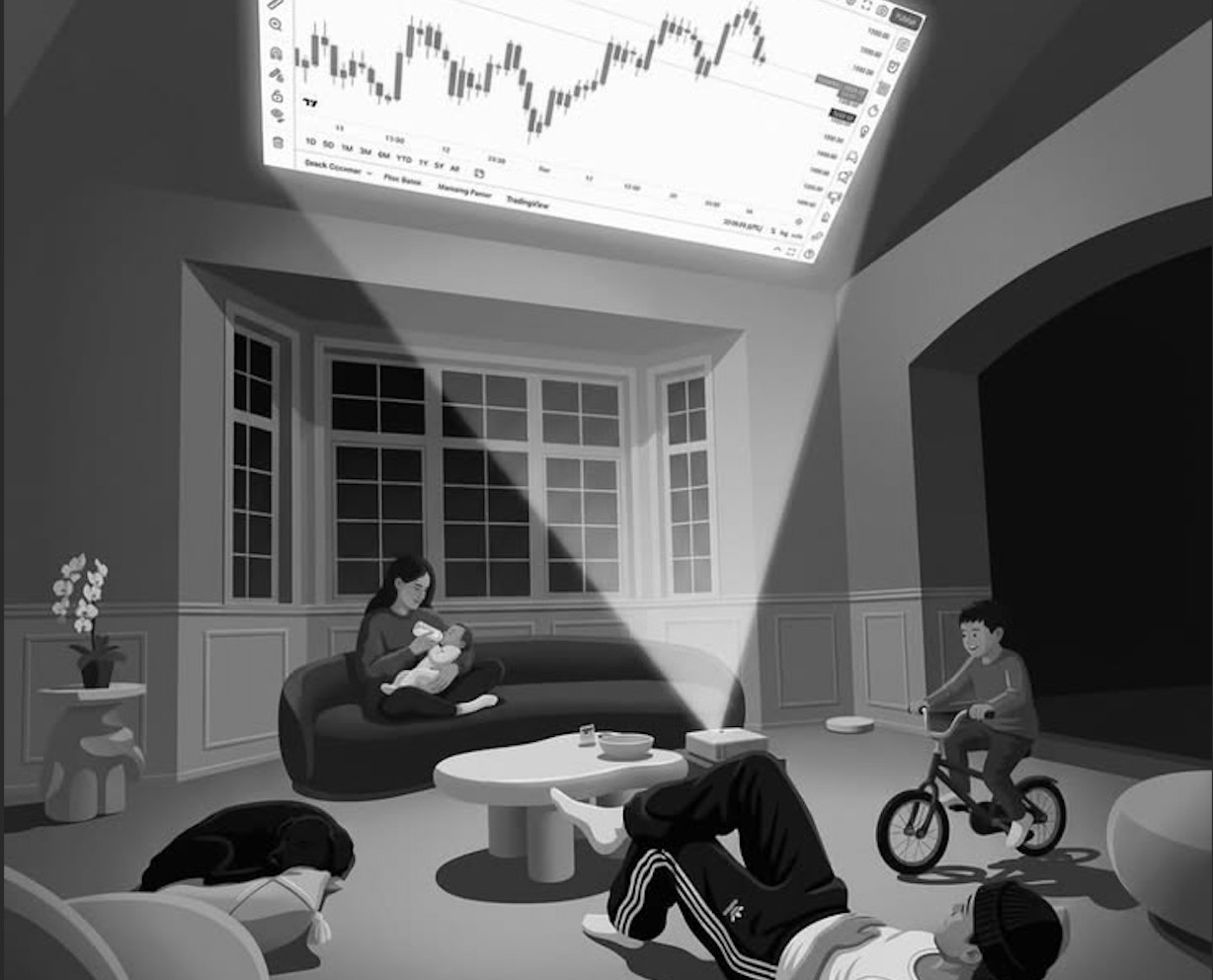
Everything connected to AI was moving, the moves were large and they were legible, and the feeling that arrives is not greed exactly. It is closer to embarrassment. You are sitting still while something obvious happens in front of you, and sitting still starts to feel like a failure of nerve rather than a decision. I got as far as thinking seriously about how I would size it. Then I went and read what actually happens to people who do this, and the feeling went away and has not come back.
Start with the people who are equipped for it.
Seventy-nine percent of actively managed US large-cap funds underperformed the S&P 500 in 2025. Over twenty years, roughly ninety-two percent of domestic funds underperformed their benchmarks. And the survivors flatter the picture: nearly sixty-four percent of domestic stock funds were closed or merged over the twenty years ending 2024, which means the record you are looking at has already had most of its failures deleted.
Now hold that number next to what those firms have. Bloomberg terminals and paid data nobody outside the industry sees. Execution desks and fee structures a retail account cannot access. Analysts who cover eleven companies each and have done so for a decade. Direct access to management. Securities lending, leverage, the ability to be patient with someone else's capital. Legal and compliance to keep them out of the traps. Full-time attention, every day, as a job rather than as a thing done between meetings.
Nine out of ten of them still lose to the index over twenty years.
You have a phone and an opinion. The honest inference is not that you might be the exception. It is that the equipped version of you already tried, at scale, with every advantage, and mostly failed, and you are proposing to attempt the same thing stripped of all of it. Retail is not a slightly worse version of that outcome. It is the same outcome with the tools removed.
The direct measurements agree. Chague, De-Losso and Giovannetti took every individual who began day trading index futures in Brazil between 2013 and 2015. Of those who persisted beyond three hundred sessions, the group you would expect to have learned something, ninety-seven percent lost money and just 1.1 percent earned more than the minimum wage. Barber, Lee, Liu and Odean found the same across fifteen years of the entire Taiwanese market: under one percent earned reliable profits net of fees, and losing did not make people stop.
The part that is actually surprising
You do not need to beat anything. You need to not damage what you already own.
Morningstar measures this every year. Over the decade to 2025, the average dollar invested in US funds and ETFs earned 8.7 percent a year, while those same funds returned 9.9 percent. The gap is 1.2 points annually, roughly 3.8 trillion dollars of foregone wealth, and it is created entirely by when people bought and sold. Nobody picked the wrong fund. They touched the right one.
The gradient inside that number is the whole argument. For the least volatile quintile of funds the gap was 0.4 points. For the most volatile it was 2.1. And for spot crypto ETFs, from launch in January 2024 through June 2026, the average dollar lost about 5.8 percent a year while the funds themselves returned 8.5 percent. A gap above fourteen points.
Read that twice. The asset went up. The people who owned it went down. Not because they chose wrong, but because they kept trying to improve on owning it, and every improvement cost them.
This is the case for holding outlier assets rather than trading them, stated by the data rather than asserted. If you bought Bitcoin and did nothing, you captured it. You did not have to be right about the halving, the ETF approval, the regulatory cycle, the macro or any particular week. You had to be right once and then absent. The people who tried to be right forty more times after that gave the position back in pieces.
There is a structural reason this is not fixable by being smarter. In most jurisdictions every sale is a taxable event. A strategy that requires realisation cannot compound before tax. The compounding machine runs on the money you did not take out, and trading is the practice of taking it out repeatedly and calling it discipline.
Price the attempt, not just the outcome
Suppose you are the exception. Suppose you do it and you win.
Put a number on the win. Full attention, market hours, pre-market reading, evenings on the charts, weekends on the thesis, and you beat the index by two points on the capital you actually have. On two hundred thousand dollars that is four thousand dollars a year, against an index return you could have had by doing nothing, on a schedule that permits nothing else.
Now price what you sold to buy it. A year of your attention is the input to every non-financial thing you might own: a business, a skill, a client base, an audience, a deal. Those things do not merely pay better in expectation. They pay in a different currency, because they are uncorrelated to the market and to each other, and because they belong to you rather than to a position.
And there is a second-order effect that people miss entirely. Income that does not depend on the market makes you a better investor. Not metaphorically. If your rent is not a function of your portfolio, you can hold through a forty percent drawdown, because the drawdown is uncomfortable rather than existential. The trader has arranged his life so that the exact moment when holding is most valuable is the moment he is least able to do it. He has taken the one behaviour that actually produces returns and made himself incapable of it.
Who is actually making money here
Not the people posting.
Kakhbod, Kazempour, Livdan and Schürhoff classified more than twenty-nine thousand financial influencers by the realised performance of what they recommended. Twenty-eight percent were skilled, producing about 2.6 percent monthly abnormal returns. Fifty-six percent had negative skill, producing minus 2.3 percent. So a majority of the people teaching this actively destroy value for anyone who follows them.
Then the finding that matters. The antiskilled had more followers and more influence on retail trading than the skilled. And the more frequently someone posted, the less likely they were to be skilled.
That is not a scandal. It is a sorting mechanism doing exactly what it was built to do. The platform selects for engagement, and confident daily predictions are more engaging than infrequent uncertain ones, so the loudest voice in your feed is systematically the least reliable one, and it got there by being wrong in an entertaining way. Meanwhile the revenue is not in the trading. It is in the course, the signals group, the affiliate link to the broker and the sponsorship. The account is a marketing asset for a business that sells to people who want to trade, which makes you the product and not the peer.
You are also seeing a filtered sample. Ten thousand people run the strategy, fifty get a good year, those fifty post their statements, and the other nine thousand nine hundred and fifty quietly stop posting. You are not watching skill. You are watching the right tail, self-selected for visibility, presented as the middle of the distribution.
Where the inefficiency actually is
Markets are not efficient everywhere. They are efficient where ten thousand funded professionals are looking at the same screen as you.
Nobody is competing for the second-generation industrial business in a town of forty thousand whose owner is sixty-eight and has no successor. The price there is set by one buyer and one seller with asymmetric information and no auction. That is where the mispricing lives, and it is why I spend my time backing people who acquire and operate rather than people who forecast.
I will not pretend that is free. It requires real capital, a personal guarantee, illiquidity measured in years, and concentration that would be reckless in a portfolio and is simply the nature of the thing here. The barrier is not an inconvenience attached to the return. The barrier is the return. Anything anyone can do from a phone in twenty seconds has already had its excess return competed away by people who can do it faster than you.
So, plainly.
The professionals lose to the index with every advantage. You would attempt it with none of them. The measurable cost of participating is not the money you lose on bad trades, it is the 1.2 points a year you remove from assets that were already working, and it is larger the better the asset is. The people teaching it are worse than random and are paid by the teaching. And if you somehow win, you will have spent the most productive years of your attention to add two points to a small number, while making yourself emotionally incapable of the one behaviour that actually compounds.
You day trade, you stupid. Not because you cannot win. Because winning is worth less than what it costs you, and you will probably not win.
Sources
S&P Dow Jones Indices, SPIVA US Scorecard, year-end 2025 (spglobal.com); Morningstar, "Mind the Gap 2026" (morningstar.com); Chague, De-Losso and Giovannetti, "Day Trading for a Living?" (SSRN); Barber, Lee, Liu and Odean, "Do Day Traders Rationally Learn About Their Ability?" (SSRN); Kakhbod, Kazempour, Livdan and Schürhoff, "Finfluencers" (SSRN).