Lud Schroedl · 17 September 2026
You gamble, you stupid
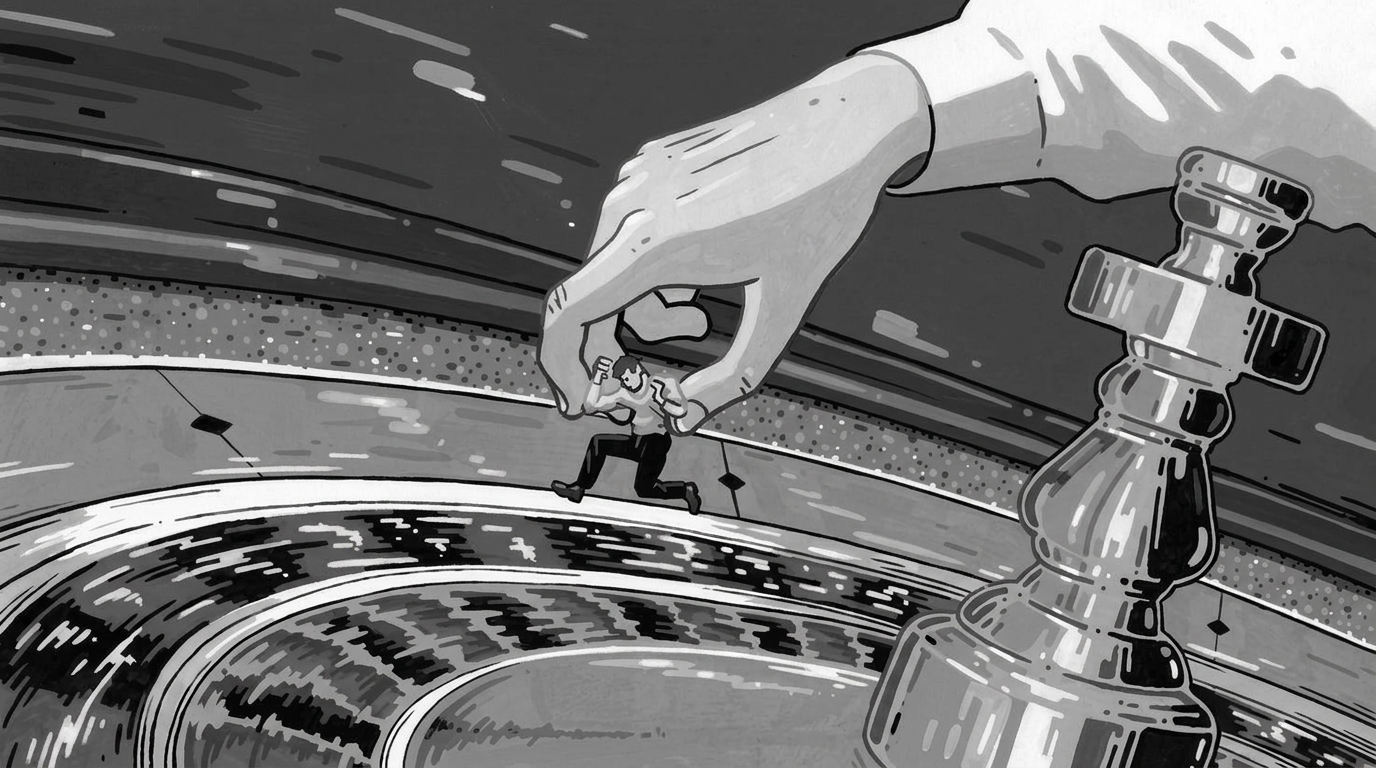
What made me pay attention was not the advertising. Advertising I can ignore. It was that the gambling itself had become the content.
A man at a laptop spinning slots for six hours, a camera walking a casino floor, a phone propped at a blackjack table, a wager placed on camera and the reaction filmed rather than the wager. Musicians do it, fighters and promoters do it, streamers whose audience is mostly teenagers do it. The product is not being advertised. The product is being performed. The audience is not being told that this is fun. They are being shown a person having fun, which is a much older and much stronger technology.
Ask why this channel exists at all, and the answer is not cultural. It is margin.
A regulated US sportsbook kept about ten cents of every dollar wagered in 2025. It keeps it immediately, and it keeps it again on the next wager. A broad index fund earns something like five basis points a year on money it holds for a decade. Put those two businesses in the same room and ask them to bid for one hour of a twenty-five-year-old's attention. One of them can pay roughly a hundred times more, and can pay today. The auction is not close. Nobody had to conspire. The house simply outbid the index fund for the same eyeballs, and then bought the most effective distribution that money has ever been able to buy, which is a person your age who seems to like you.
The product also got more expensive while this was happening. The national hold on US sports betting was around 6.9 percent in 2019 and around 10.2 percent in 2025. That is design. The growth came from parlays, which feel like skill and price like a lottery ticket.
Then there is the question of what you are actually watching.
Bloomberg Businessweek reviewed roughly 1,500 hours of livestreamed gambling on Kick from 25 players, and analysed about 500 hours of slot play in detail. On games made by the casino's own in-house studio, two of its biggest paid promoters hit wins of a thousand times their bet about four times more often than the baseline rate: roughly one in 2,500 spins against roughly one in 10,000. On slots made by third parties, the same players performed normally. The casino says the analysis is wrong. Set the dispute aside, because the dispute is not the point. Researchers have also noted that sponsored streamers are sometimes playing with the operator's money rather than their own.
Whatever the truth of any single account, you are not watching a random sample of the outcome distribution. You are watching the tail, selected, edited and broadcast by the party that profits when you conclude the tail is normal. Nobody has to lie for that to work.
That is the old part. Here is the new part, and it is the reason I am writing this down.
The activity has acquired a better word. It is no longer called betting. It is called an event contract, or a prediction market, and it is traded on a venue with an order book, a fee schedule and a regulator. In a survey of a thousand retail investors this year, one in four of the youngest cohort said sports betting was a deliberate part of their long-term financial strategy.
I want to be fair to the instrument, because the lazy version of this argument is wrong. An event contract is not structurally a casino. There is no house edge built into it. The fees are small. The prices these venues produce are a genuine public good, often better calibrated than the experts they embarrass.
In the right hands it is a real financial instrument. Someone running a model over enough resolved events, sizing positions against a measured edge, using a contract to hedge an exposure that nothing else hedges cleanly, is doing serious work. Over a long enough series that can be a strategy. I have no argument with that person and I expect there to be more of them.
That person is a rounding error. Across $67 billion of traded volume on the largest of these venues, the top one percent of profitable users captured more than three quarters of all profits. A separate analysis of two and a half million accounts found more than eight in ten losing money. The mechanism is visible in the order flow: the people who make money post limit orders and provide liquidity, and the people who lose money hit market orders and take it.
So you are not trading against the house. You are the liquidity. It is a fair market, and you are the thing being farmed in it.
The difference between those two activities is not the venue, the asset or the vocabulary. It is whether the position exists because a process produced it, or because the game was on and the screen was open. One of those is a strategy that happens to use contracts. The other is gambling that happens to have an order book.
Even winning does not give you what you think it gives you. An event contract resolves and pays cash. There is no reinvestment loop inside it. A share in a business throws off cash that buys more of the business, which throws off more cash, and that mechanism runs while you sleep and while you are wrong about other things. The contract has no such property. You can be skilled at this for twenty years and still be doing piecework the entire time, starting from zero on every ticket.
The money is the cheapest thing you lose.
The expensive part is the metabolism you acquire. A position that resolves in ninety minutes teaches you to expect resolution in ninety minutes. You check your phone during dinner. You develop opinions about matters you have no information about, and you hold them with money, which makes them feel like knowledge. You become the kind of person who needs the next thing to be happening. Then you try to sit with a business that will take six years to be worth anything, and you cannot do it, and you will not know why.
This is the same illness as the shiny object, wearing better clothes. My generation wants the money now, the body now, the relationship now, the company now. What we do not want is the part in the middle, which is long, unwitnessed and boring, and which is the only part that produces anything. All the returns in life come from compound interest. Compounding is a promise about the end of a curve, and the entrance fee is the flat part at the beginning, where nothing appears to be happening and nobody is clapping.
There is one more cost, and it is the one that actually worries me.
Gambling used to carry a mark - information. It told a young man that this activity had ruined people, and that ruin was the expected case rather than the unlucky one. Give the same activity a new name, put it in an app next to his index fund, let him post his tickets publicly and be admired for the ones that hit, and the mark comes off. Nothing about the expected value changed. Only the shame did. Shame was doing real work, and it was removed on purpose, by people who profit from its absence.
The product exists so that you lose. It is priced so that you lose slowly enough to keep going. It is marketed by people who are paid whether or not they lose. The venue that looks most like investing delivers the same distribution of outcomes as the one that does not, because the name on the app was never what decided that. And the cost you should care about is not the balance on the screen. It is that you are training yourself, on purpose, to be someone who cannot wait.
Doing this will not turn you into an investor. It will turn you into someone who recognises the feeling of investing.
You gamble, you stupid. I say it that way because it needs to be short enough to remember at eleven at night with the app open.
Sources
American Gaming Association commercial gaming revenue data, 2025 (aga.org); Baker, Johnson, Kotter and Pisciotta, "Gambling Away Stability: Sports Betting's Impact on Vulnerable Households", Journal of Financial Economics, 2026, which found household net brokerage investment fell about 20 percent after online sports betting was legalised (BYU summary); Bloomberg Businessweek, "How to Win Slots and Influence People", February 2026 (bloomberg.com); Akey, Grégoire, Harvie and Martineau, "Who Wins and Who Loses In Prediction Markets? Evidence from Polymarket" (SSRN); Betterment 2026 Retail Investor Survey.